


The Phaedo is a beautiful dialogue—but it is also a labyrinth. It is very easy to become lost and succumb to the fear of death. The dialogue captures the final hours of Socrates where he discusses the immortality of the soul and faces death with unparalleled courage and philosophical clarity. While the opening myth of Theseus deserves special attention, the immortality of the soul is central and presented in four key arguments—cyclical, recollection, affinity, and final cause—which wrestle with the mystery of life and death.
The Phaedo is also a writing of hope. Socrates has a serene acceptance of death, and he, as the one slotted to die, is comforting his friends.
Why is the Phaedo worth reading?
It challenges us to confront life’s ultimate questions with courage and openness, as Socrates does in his final moments, facing death with the hope of death being a good. For Christians, how much less should Christians fear death than the pagan Socrates? Yet, Socrates’ tranquility and courage in the face of death is a high standard. The Phaedo’s blend of rigorous argument and delightful drama invites us to think and live philosophically—a life of wisdom and virtue.
Here are the Ascend Book Club materials to help you read:
A detailed Q&A guide with everything you need to know about the Phaedo
An excellent discussion on just the opening of the dialogue (below)
Two conversations walking step-by-step through Phaedo’s arguments (below)
All three conversations are also posted as podcasts
Check out “Is the Soul Immortal?” an article exploring the Phaedo
The Phaedo is often read alongside other dialogues as the “last days of Socrates:” the Euthyphro (before his trial), the Apology (during his trial), the Crito (in prison), and the Phaedo (his death).
Join our reading group and study the great books with us!
To support our mission and get all our resources, become a paid book club member. In addition to the weekly podcast, you’ll get:
Live book club discussions with Dcn. Garlick & guest scholars (monthly)
In-depth reading guides and essays to lead you through the great books
Access to our incredible community of readers
The full archive of members-only content (guides, essays, and podcasts)
Video Discussions on the Phaedo
In this episode, we are introducing Plato's Phaedo, "on the soul," with Alec Bianco of the Circe Institute and with Athenian Stranger. We'll discuss why to read the great books, why we read Plato, how you should read Plato, and why to read the Phaedo. We then do a deep dive into the opening of the Phaedo, especially on the setting and the myth of Theseus-where a subtle, attentive read unearths a beautifully rich allusion. We'll end with some advice for first time readers of the Phaedo.
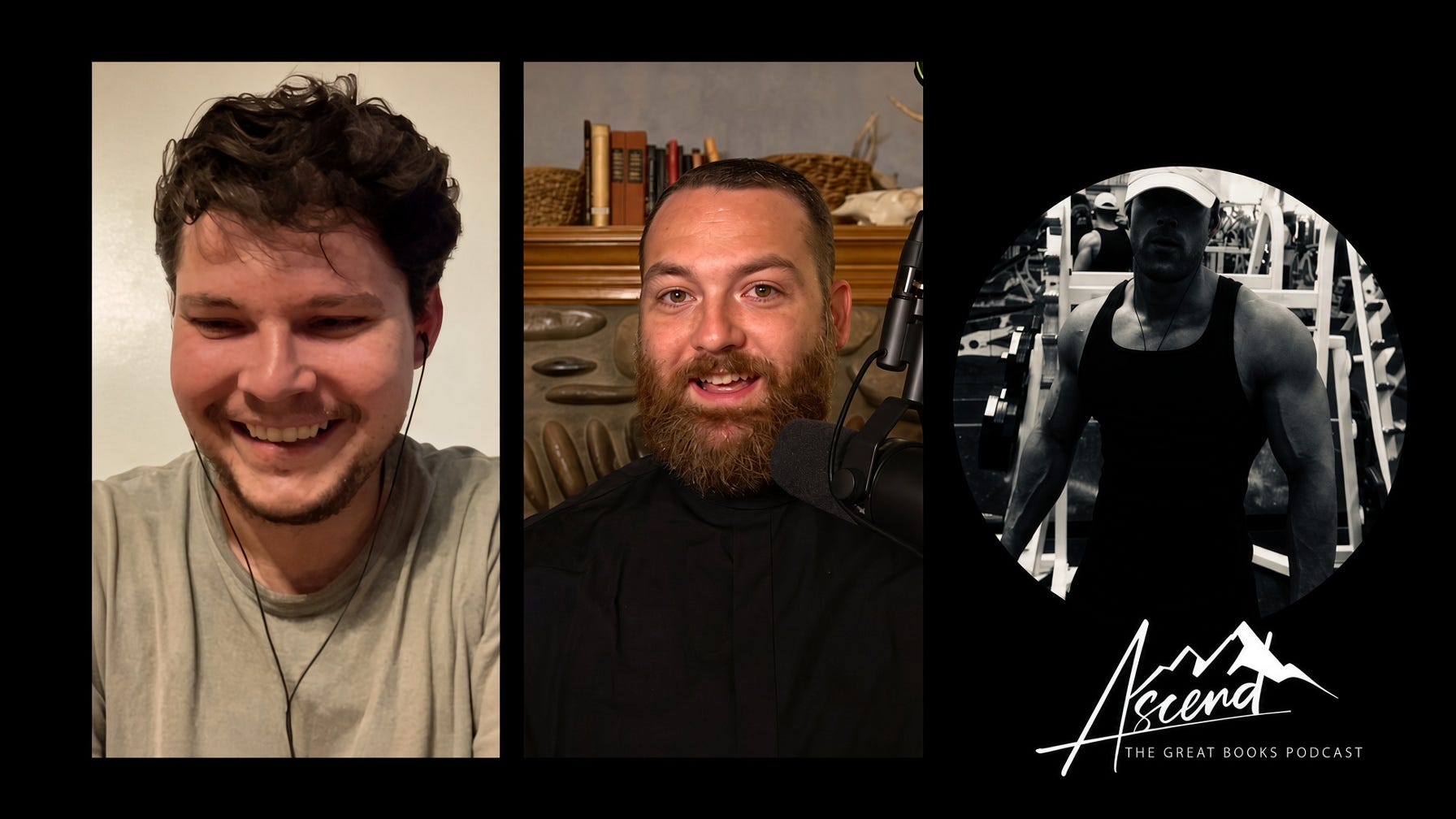
In this episode, we are discussing Plato's Phaedo, or in ancient times, it had the subtitle of “On the Soul.” It tells of the death of Socrates and his various arguments for the immortality of the soul. The Phaedo is a complicated dialogue. It's a long dialogue, but it's very beautiful and very much worth the effort. So it merits a slow, attentive, and subtle read.
And to help us with this type of read, we are joined by Dr. Christopher Frey, a fantastic thinker who really is going to hold our hand and walk us through these various arguments of the immortality of the soul. We're going to discuss the first part this week (up to the theory of recollection) and the second part next week.
So is it beautiful? Yes. Is it difficult? Also, yes, but it's very much worth your time. So join us today for an excellent conversation on Plato's Phaedo with Dr. Christopher Frey.
In this episode, Dcn. Garlick and Dr. Frey dive into the second half of the text (72e–118a), unpacking the recollection and affinity arguments, objections from Simmias and Cebes, the concept of misology, the final cause argument, the myth of the afterlife, and Socrates’ enigmatic final words.
Good work! You’ve finished the dialogues dealing with the last days of Socrates—but don’t stop here. Next on the docket is Plato’s Meno, an excellent dialogue on virtue and education, and Plato’s Gorgias, a long but rich dialogue on rhetoric that matures into a discussion on the good life.
Be sure to check out our entire, growing library on Plato.
Dcn. Harrison Garlick lives in rural Oklahoma with his wife and five children. He serves as a deacon at Holy Family Cathedral and as Chancellor & General Counsel for the Roman Catholic Diocese of Tulsa. Follow him on X at Dcn. Garlick or Ascend.