


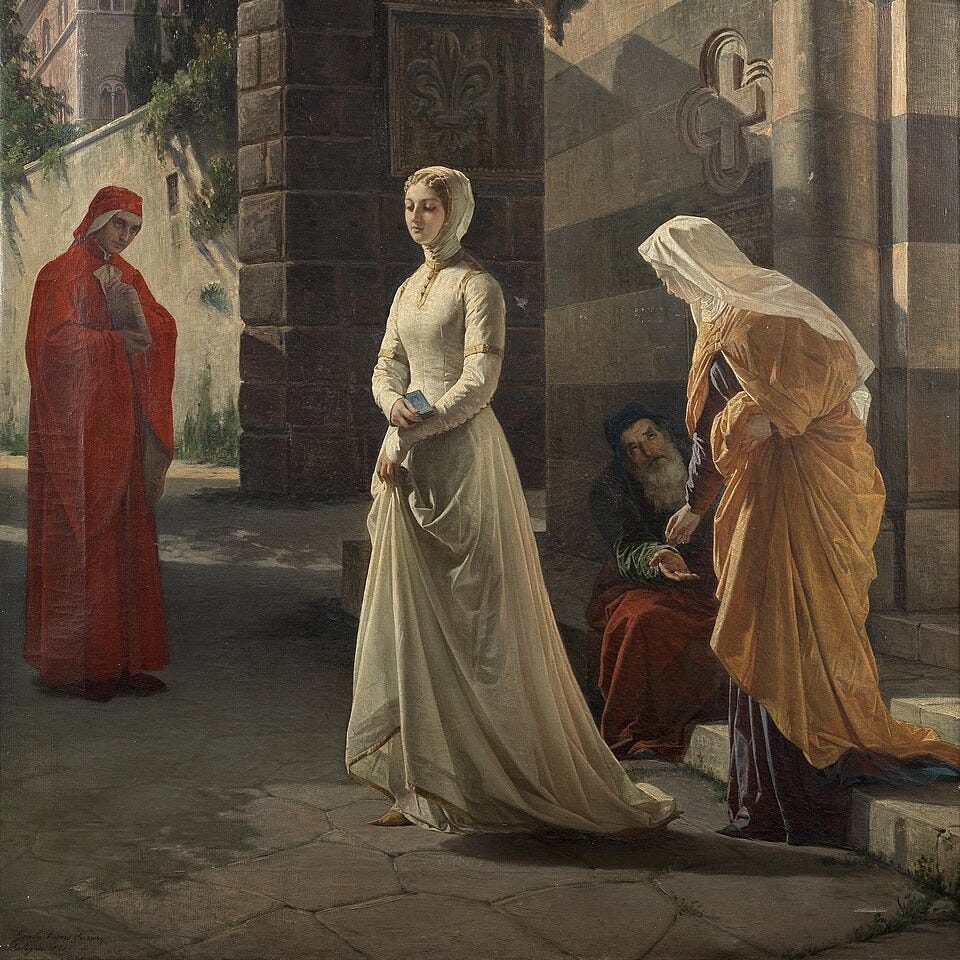
Eros is the primal desire of the human heart to satiate in beauty and to be happy.
It is enkindled in you by God to lead you back to Him, Beauty-Itself.
And the beauty of woman plays a vital role in this erotic ascent.
Yet today we tend to receive the female form either pornographically or puritanically — both of which miss the profound spiritual reality of femininity.
This is a tremendous mistake.
The Hebrew, Greek, and Christian traditions understood something we have largely forgotten: the beauty of woman is a living icon of God — an invitation to ascend.
You can rediscover it too.
Reminder: this is a teaser of our members-only deep dives.
To support our mission and get our premium content every week, upgrade for a few dollars per month. You’ll get:
New, full-length articles every Tuesday and Friday
The entire archive of members-only essays
Access to our paid subscriber chat room
A Brief Sketch of Holy Eros
Recall that eros is your natural love that desires to satiate in beauty and be happy. It is a need-love, an existential desire for rest and satisfaction. Your eros, however, is infinite—you always want to possess the beautiful and be happy. You never desire to be unhappy. As such, your eros is either doomed to move through life satiating on one finite beauty after another—a listless pattern of consumption—or the endlessness of your eros is a clue imprinted upon your soul that it was made for an infinite beauty—this infinite beauty we call God, Beauty-itself.
In other words, the primal desire of the human heart, eros, was enkindled in you to lead you back to God—only in Him is there true rest and bliss.
But how do you ascend to this Beauty-itself?
Eros is a love of ascent. Like fire, it has the nature of tending upward, being desirous of moving from lesser beauties to greater beauties until it finds the All-Beauty, God. It was in Plato’s Symposium that Diotima, a foreign woman, taught Socrates about what it truly meant to be skilled in love or “skilled in erotics.” To wit, the ascent of eros is an image of a perfection of the soul. You climb the “ladder of love” toward greater beauties and the divine by perfecting the loves of the soul and its hierarchy. The soul that ascends is a soul well-ordered.
The first thousand years of Christianity often presents the soul in a platonic fashion, in which the soul has three parts from lowest to highest: the appetitive that loves pleasure, the spirited that loves nobility, and the intellect that loves truth. The ascent of eros is learning how to moderate your love of pleasure while ascending to the greater loves of nobility and truth.
The greatest love of the soul is God, Beauty-itself.
And this truth is expressed in the Christian tradition as well.

Eros in Christianity
In Christianity, the erotic has always been a sign of humanity’s relation to God. In the Old Testament, the love between God and Israel was presented as a marriage covenant, often in erotic images, and idolatry was presented as spiritual adultery. In the New Testament, Christ is the groom and the Church is the bride, who come together in one flesh with Christ as the head and the Church as the body. The Bible begins with the marriage of Adam and Eve and ends with the marriage high feast of the Lamb.
Christians hold that the images of the erotic, either of ascent or of marital union, were adopted into Christian spirituality and perfected by the reality of Jesus Christ. St. Gregory of Nyssa presents Moses ascending Mt. Sinai into the bright darkness of God as an analogue of soul’s erotic ascent to God. St. Augustine’s ecstasy at Ostia in his Confessions shows that the saint understands the soul’s ascent to God is both upward and inward—the higher the soul ascends, the more it explores the depths of itself. St. John Climacus wrote the famous Ladder of Divine Ascent, and the saints like St. Bernard of Clairvaux, St. Teresa of Avila, and St. John of the Cross adopted marital erotics to describe the spiritual union of Christ and the soul, the spirituality known as bridal mysticism.
Eros, though often forgotten or misunderstood, permeates both Hebrew and Greek thought leading up to Christ and then is inseparable from the spirituality of early Christianity.
For a thorough introduction to eros both in Plato and Christianity, see Reclaiming Holy Eros.
The Question of Femininity
The erotic appetites of the soul are the primal driving force of humanity. You and every person around you are driven by what they believe to be beautiful and what, if possessed, will make them happy.
The question of erotics is the question of the human condition. It percolates underneath all discussions on religion and politics. To understand eros is to understand what it means to be human.
But do women have a unique role within this cosmic ladder of love?
Both men and women share the same structure of the soul and the same erotic longings for happiness. Moreover, both men and women are made in the Image of God, the Imago Dei, and both look to Jesus Christ, the “image of the invisible God,” to understand how to perfect the Image of God in them.
Yet men and women are different.
Male and female are both reflections of God but remain distinct.
The question is whether the female, as an Image of God, is a unique reflection of the divine—and, if so, what is the role of that reflection in the soul’s ascent to God?
What is the spiritual reality of femininity within eros?
Does the beauty of femininity have a role in orienting the soul toward Beauty-itself?
The ancients have an answer.
