


Do not pity the damned.
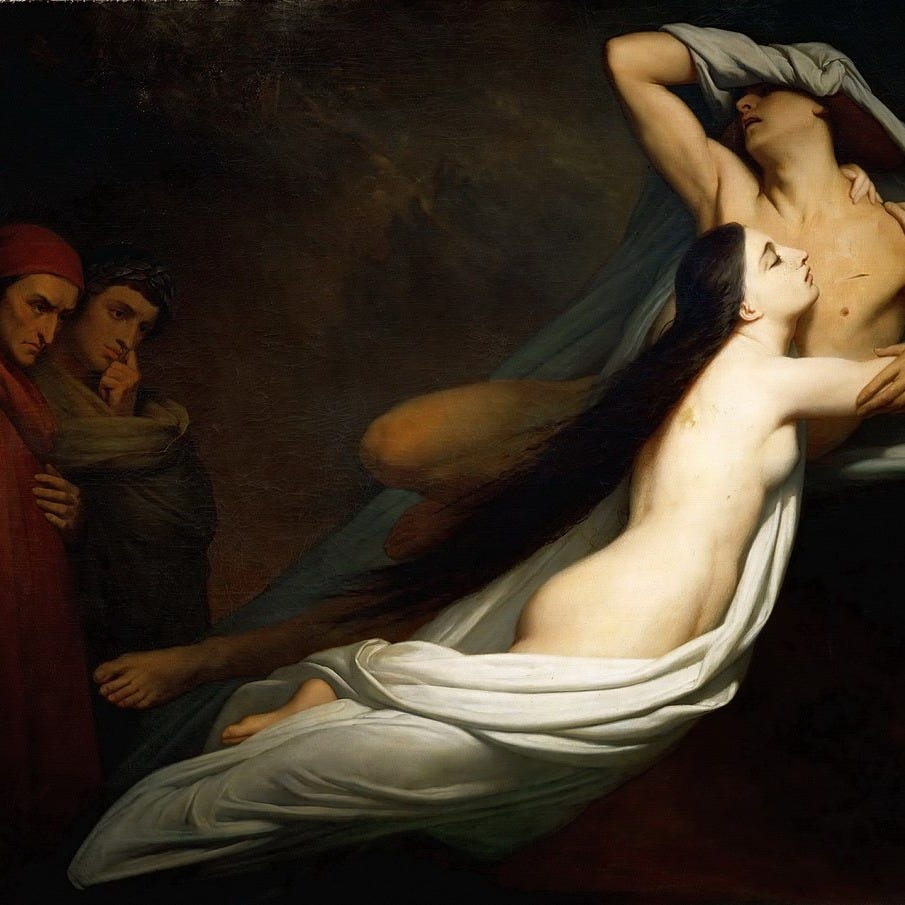
In the second circle of hell, Dante the Pilgrim sees Francesca intertwined with her lover Paolo, battered about by the winds of hell.
She tells her story to Dante the Pilgrim—and what follows is one of the most important lessons in the entire Comedy.
Dante the Pilgrim fails the test.
But here is the kicker—so do many who read the Inferno (even professional commentators).
In the seduction of Francesca, Dante the Poet offers you one of the most important spiritual lessons in the Divine Comedy.
Reminder: this is a teaser of our members-only deep dives.
To support our mission and get our premium content every week, upgrade for a few dollars per month. You’ll get:
New, full-length articles every Tuesday and Friday
The entire archive of members-only essays
Access to our paid subscriber chat room
The Souls in the Storm of Hell
In Dante’s Inferno, the second circle of hell punishes the sin of lust. The circle is part of “upper hell” that punishes sins of incontinence—or rather those souls that failed to moderate their love of some good, e.g., the body, food, wealth, and even anger. Each circle has a “contrapasso” or rather a punishment that is tailored to the sin—in the Inferno, the souls are given over to the disorder of the sin itself.
In the second circle, Virgil and Dante the Pilgrim see the damned condemned for lust being battered and tossed about by a giant storm. What do strong winds have to do with the sin of lust? Well, these souls allowed their souls to be pushed around by their desires—they failed to anchor their soul to reason. To wit, as they treated their souls in life, they are now treated for eternity in death.
Amongst these souls, Dante the Pilgrim sees such famous figures as Cleopatra, Helen, Achilles, Paris, and Tristan. Yet, amongst the chaotic tumult, he sees two intertwined shades: Francesca da Rimini and her lover Paolo.
Francesca, coupled with Paolo, starts to tell Virgil and Dante the Pilgrim her story.
And what follows is one of the most important lessons in the entire Comedy.
The Story of Francesca & Paolo
Francesca da Rimini, a noblewoman from Ravenna, was married in AD 1275 to Gianciotto Malatesta (also known as Giovanni or “Crippled John”), the deformed and uncouth heir of the powerful Malatesta family ruling Rimini, in a political arrangement intended to secure peace between the warring city-states of Ravenna and Rimini; according to tradition, the handsome and courteous Paolo Malatesta, Gianciotto’s younger brother, was sent in proxy to wed her as a stand-in for his brother, leading her to fall in love with him.
Francesca tells Dante the Pilgrim about a time she and Paolo were reading the romantic (and adulterous) tales of Lancelot and Guinevere together, until the fateful moment when their desire overwhelmed them and they “read no more.”
Careful reading of the passage shows that Francesca, in her story to Dante the Pilgrim, takes no responsibility for her actions—rather, she presents her desire for Paolo as an irresistible love. In other words, her fall into lust and adultery was something that happened to her and not something she willed. And, as such, she should not be punished and it is a shame that this woman now suffers in hell.
But here is what you have to see.
As Francesca seduced Paolo, she now seduces Dante the Pilgrim.
He falls for her rhetoric and it moves his heart overwhelmed with pity and he faints.
It is here that Dante the Poet shows you one of the most important spiritual teachings of the entire Divine Comedy.
In fact, it is a test that even many modern commentators fail. Like Dante the Pilgrim, many modern commentators on the Inferno hold that Francesca has conquered hell! That her love for Paolo, with whom she is forever intertwined, has endured eternal judgment.
But like Dante the Pilgrim, Francesca has seduced the commentators of the Comedy with her rhetoric.
They pity her.
And they, like Dante the Pilgrim, they fail to grasp one of the greatest lessons in the Inferno.