


Hell is structured by love.
In the third circle of Dante’s Inferno, the gluttons lie sprawled in a putrid slush of endless rain, hail, and snow, wallowing like pigs in the filth.
The punishment fits the sin: what was warm indulgence on earth is now eternal, freezing squalor.
But the lessons of Dante are much more than the obvious.
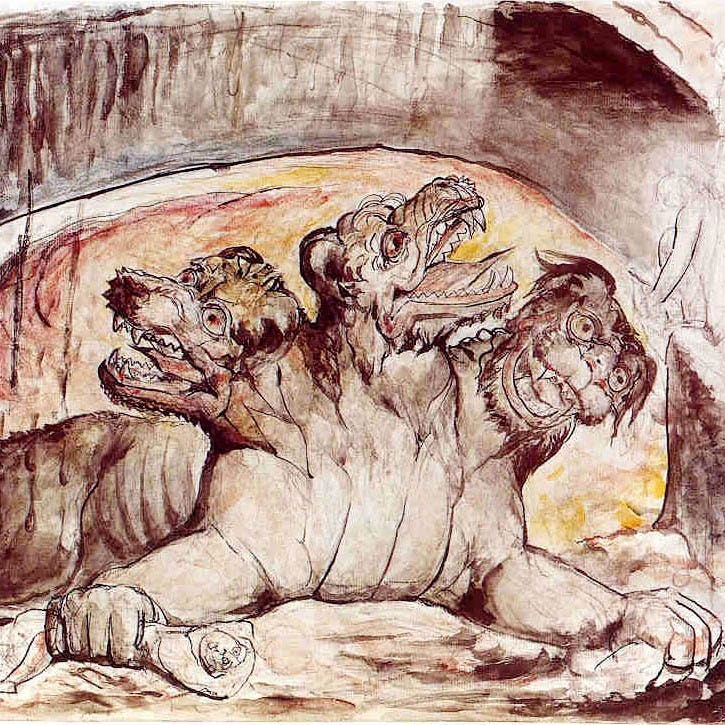
The true horror—the deepest spiritual wound of gluttony—lurks in the circle’s monstrous guardian. It is in the creature that the lesson of how an unbridled appetite distorts your soul is best learned, as the rational soul falls into a bestial existence.
And once you grasp this, you see not only the depravity of the sin... but the clear path to conquering it in your own life.
Reminder: this is a teaser of our members-only deep dives.
To support our mission and get our premium content every week, upgrade for a few dollars per month. You’ll get:
New, full-length articles every Tuesday and Friday
The entire archive of members-only essays
Access to our paid subscriber chat room
How is Dante’s Inferno Structured?
Hell is structured according to love. Dante’s hell is composed of two general areas: an upper hell and a lower hell. The upper hell contains souls condemned for sins of incontinence or rather an inability to control one’s desires toward a good (e.g., lust, greed etc.), while lower hell is marked by sins of malice—a malevolent will toward yourself or others. Lower hell has two main sections: the lesser sins of violence and greater sins of fraud.
Though this is the general structure, there are a few areas that are unique: the vestibule of hell that punishes the lukewarm, the first circle of hell (limbo) that houses the naturally virtuous, and the sixth circle of hell (heresy) that serves as a boundary between upper and lower hell. Overall, the Inferno is ordered according to the severity to which a sin offends love—thus, lust, a disordered love, is at the top (second circle), while treachery is at the bottom (ninth circle).
Another way to view the structure of hell is according to the hierarchy of the soul. For example, Dante was familiar with St. Augustine, and St. Augustine often plays off the platonic understanding of the tripartite soul: the intellect that loves truth, the spirited part (thumos) that loves nobility, and the appetitive that loves pleasure. And these three should exist in hierarchy, with the intellect governing both the spirited and the appetitive, and the spirited helping the intellect to govern the appetitive.
Now, remember the important principle that the corruption of the best is the worst. In other words, the higher the angel, the greater the demon; thus, the structure of hell can also be seen as a map of the disordered soul. The corruption of the lowest part, the appetitive, would be least offensive, and this represents the sins of incontinence (e.g., lust, greed, etc.).
The spirited part of the soul loves nobility, honor, glory, and victory—and these are difficult to obtain; thus, the spirited part, via anger, courage, perseverance, etc., helps the soul overcome difficulties for the sake of some good (like Christ cleansing the temple). But it can also be corrupted, and an unbridled thumos can lead to sins like murder and tyranny, and these are represented in the first part (sins of violence) of the lower part of hell (the sins of malice).
And since the corruption of the best is the worst, the worst sins you can commit are sins corrupting the best part of your soul, the intellect. As such, Dante places fraud—a disordered use of your intellect—in the lowest section of hell. Instead of being used to discover truth and share that truth with others, the damned used their intellect to deceive. Fraud is contrary to the very nature of man as a rational animal and is contrary to the very nature of Christ, the Truth, the Logos. Fraud is a uniquely anti-Christian act.
But where does gluttony fit into this structure?
How are the Gluttons Punished in Hell?
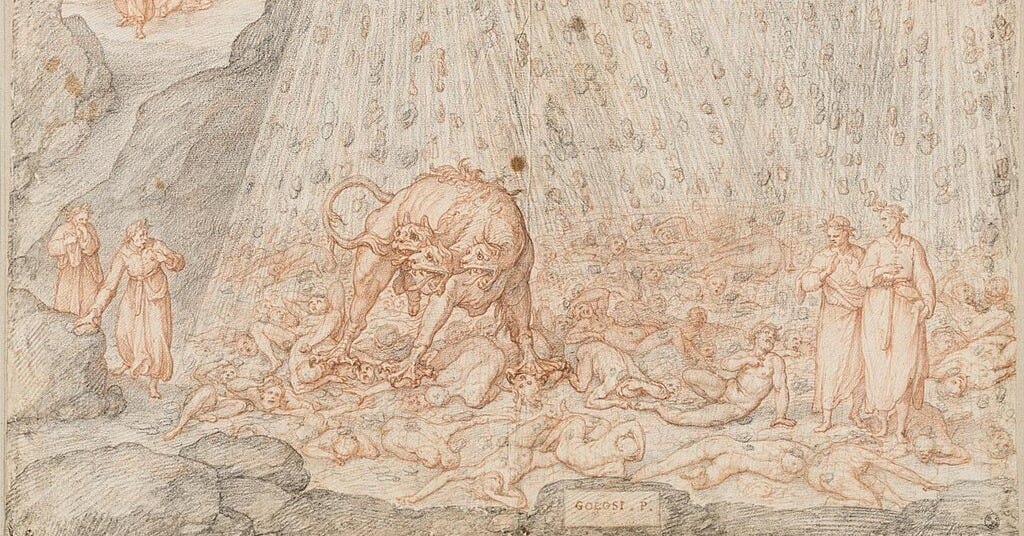
When Dante arrives at the third circle of hell, he is presented with a vision of souls rolling in filth and being battered by the elements. These are the gluttons, and they are punished amongst the sins of incontinence. All sins of incontinence represent a disordered attachment to some good (e.g., sex, wealth, etc.), and here gluttony is a disordered desire toward food. Dante presents it as a graver sin than lust but a lesser sin than the rest of the Inferno. Our attraction to food is natural, but it can become disordered—and not just in overeating but also in eating too eagerly, eating at inappropriate times, eating without need, and even being too picky about the food eaten.
But why are the gluttons punished in this manner?
In the Inferno, each sin suffers a contrapasso, which means a punishment tailored to the disorder of that sin. In hell, the contrapasso usually hands the soul deeper into its own disorder, as following St. Augustine, Dante knows that sin is its own punishment. At a preliminary glance, the contrapasso of the gluttonous souls is clear. The damned wallow in filth like pigs, and the warmth and comfort they took in food during life is replaced by an eternity of cold, sordid rain, snow, and hail.
But the real spiritual harm of gluttony is revealed in the guardian of the third circle.
Dante the Poet borrows a creature from Greek mythology, one associated with Hades, to teach a deep Christian truth about the nature of gluttony.
It is in this beast that the spiritual harm of gluttony is best seen—and then defeated.