


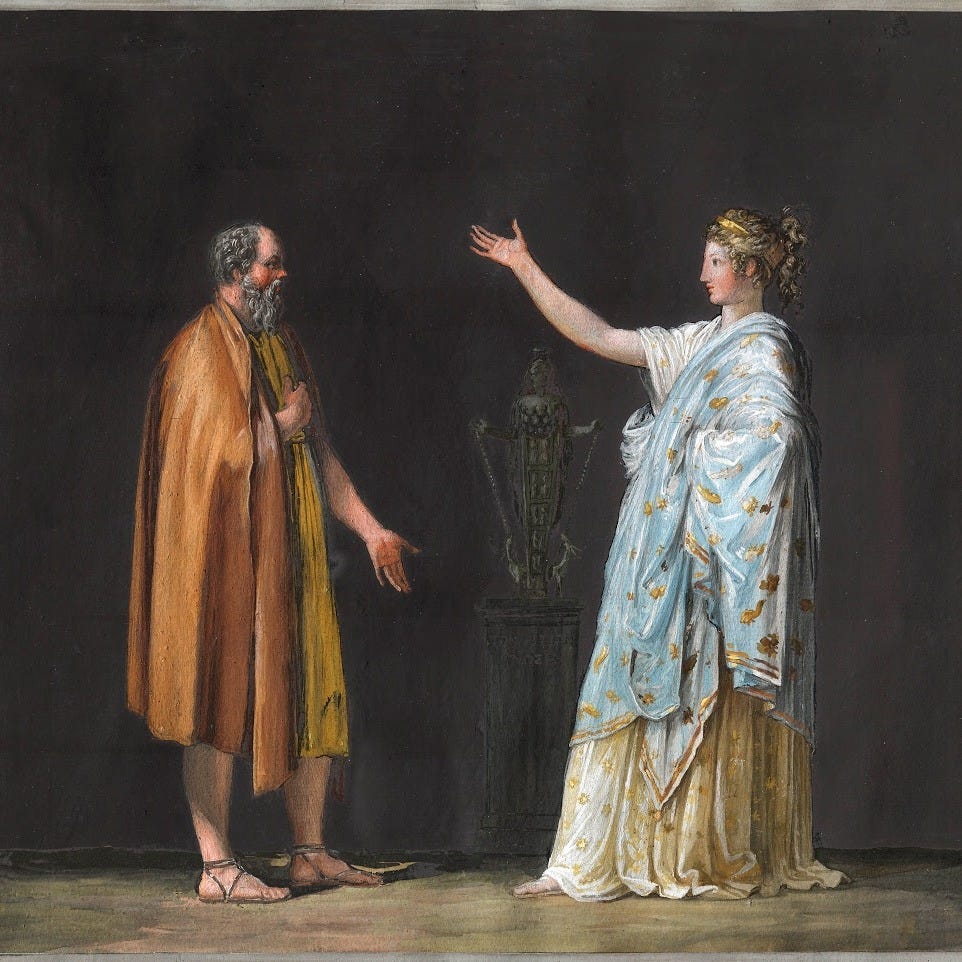
Plato is philosophy.
Many find Plato to be boring, a dry academic pursuit.
But Plato’s teachings are an invitation to become beautiful—to order the soul according to virtue and the divine.
Plato’s writings always make claims upon you soul—encouraging you to be better.
But where should you start?
Reminder: this is a teaser of our members-only deep dives.
To support our mission and get our premium content every week, upgrade for a few dollars per month. You’ll get:
New, full-length articles every Tuesday and Friday (or Saturday!)
The entire archive of members-only essays
Access to our paid subscriber chat room
Why Should You Read Plato?
Plato is philosophy. In other words, arguably all philosophy in the Western world is somehow still in dialogue with Plato. Core concepts of philosophic thought, such as the soul, virtue, teleology, objective truth, metaphysics, etc., are rooted in the teachings of Plato. Without ever having read Plato, many people think within terms and categories that bear his imprint. To read Plato is to refresh your mind on what is real and to have a better grammar to express your observations about reality.
Christianity is no different. Plato was a significant tributary into the broader Hellenized culture, which flowed into Judaism prior to Christ and then into the New Testament. Hellenized thought was not a later, alien addition to Christianity but something that prepared the world for the coming of Jesus Christ. Early Christian saints, like St. Justin Martyr (c. 100 – c. 165 AD), St. Gregory of Nyssa (c. 335 – c. 394 AD), and Dionysius (late 5th century) all found a deep harmony between Christianity and the schools of Platonic thought—though Christian revelation remained the standard by which all was judged. Even St. Thomas Aquinas (c. 1225 – 1274 AD), often presented as the zenith of Roman Catholic theology, is, despite misconceptions of him as a “pure Aristotelian,” deeply in debt to Platonic thought through St. Augustine (354 – 430 AD) and Dionysius.
Moreover, you may be surprised that Plato has a deeply moral and even mystical quality. Socrates, as Plato presents him, believes you should be virtuous—a certain health and beauty of the soul found in prudence, justice, temperance, and fortitude. Moreover, in his Symposium, Plato describes your natural love, eros, and how it is called to ascend from lesser beauties to greater beauties until it satiates on the divine beauty-itself (a pattern of ascent often re-expressed in early Christian teachings).
To wit, Plato never presents philosophy as a sterile, academic exercise. Philosophy is always an invitation to become beautiful, to have a harmonious and well-ordered soul.
But where should you start?
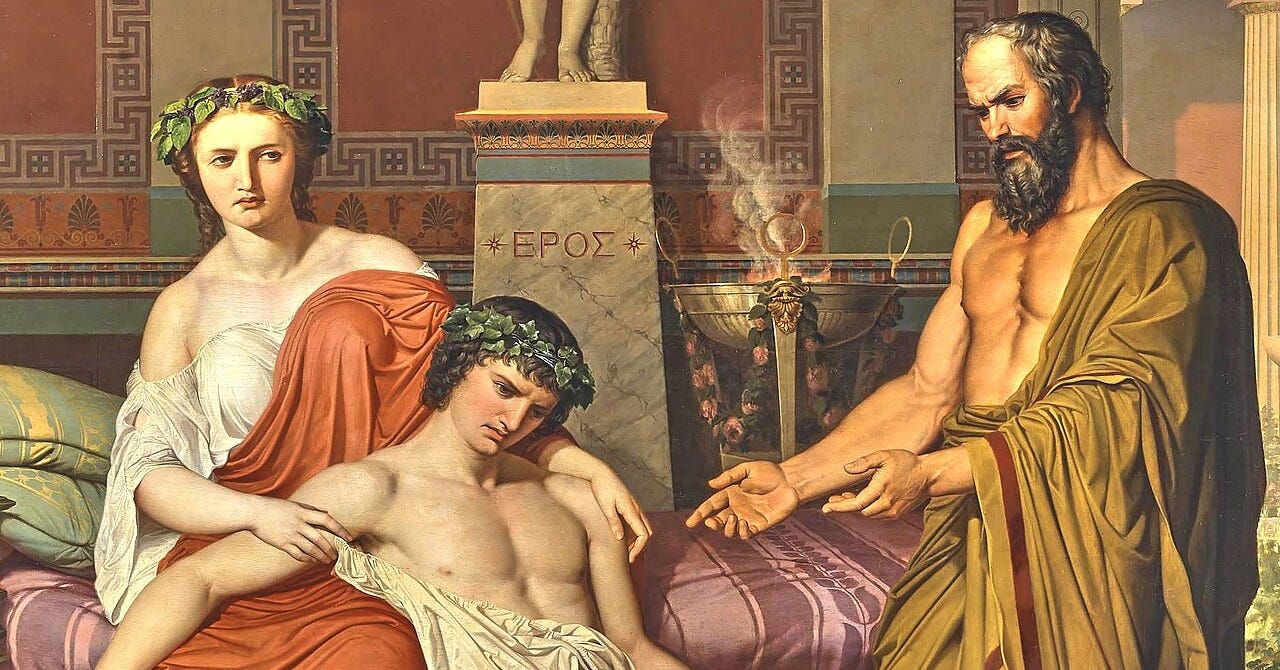
The First Dialogue You Should Read
Here are a few good options for dialogues to read first.
First Alcibiades
Often overlooked in the modern age, this dialogue was the historic, ancient place many students of Platonic thought would start. Why? Because the dialogue tells of Socrates trying to convince a young, haughty Alcibiades that he should study philosophy; thus, it presents a beautiful picture of the relation of teacher and student, and what the student must do to begin his or her path to wisdom. The dialogue teaches you about Platonic thought, but more so it instills in you the right disposition to learn more. It would be hard to go wrong with First Alcibiades.
The Euthyphro
Often the first dialogue many students of Plato read today, as it is the first of the “four last dialogues of Socrates” that tell of Socrates’ final days in Athens before his execution in 399 BC. The dialogue is a definitional one and seeks the meaning of “piety,” but it quickly escalates into a question about the nature of the gods and even how one interprets reality: subjectively or objectively. It is good for first time readers due to its explicit questions but also invites the reader into its more esoteric strata. In other words, it is a good introduction to the understanding that Plato writes on several layers. Finally, the Euthyphro also raises significant questions for Christian theology, questions Christians should take seriously about the nature of God.
The Apology
Arguably the most famous of the dialogues, the Apology recounts Socrates’ speech at his trial and shows you that Socrates is not afraid to die—in fact, he does not seem to be focused on exonerating himself at all. Rather, Socrates explains his calling from the God to try and wake up Athens from its materialistic slumber to a better type of life, the life of philosophy. It is one of the best dialogues to understand the character of Socrates and what motivates him—it is also one of the more straightforward dialogues (as it’s mainly a speech), making it a great introductory text. The Apology is often listed amongst the most important speeches in Western civilization.
The Meno
Like First Alcibiades, the Meno presents an image of what it means to be educated and how different souls respond to the invitation to education. Though the dialogue is about virtue, the responses of the characters in the dialogue make it an excellent text for new students of Plato—as it presents the reader a mirror to consider how he or she responds to being bewildered (aporia). A bit more indirect than the others, the Meno is often presented as an introductory dialogue to Plato’s Socrates for its educative principles.
Next Steps & Resources
First Alcibiades is a great place to start, but those who would like to have a more straightforward introduction to Socrates should start with the Apology. The Meno is probably the most difficult starting point, as it is both indirect and includes an elongated and complicated geometric example. The Euthyphro is simply a fun dialogue—but one that can surprise you if you read it carefully.
Plato: The Complete Works by Hackett, the “big red brick,” is an excellent book for beginners to have access to all of Plato’s writings in one text.
Lastly, if you want to read these texts in a small group vibe, check out our sister company, Ascend: The Great Books Podcast, which has a whole playlist on Plato’s works - including all those mentioned above - and even written Q&A guides to help you or your small group.
Plato is philosophy.
Reading Plato is a tutelage in what is real and an examination of the questions that gave birth to Western civilization. He is just as relevant for philosophical conversations, as he is to theological ones. Though Christians would see him bereft of divine revelation, he was not bereft of the intellect God gave him nor the book of nature God made. Recall that Christian grace builds upon nature.
You can learn a lot from reading Plato—especially because for him philosophy is not a sterile academic exercise but an invitation to configure your soul to the truth, to that which is beautiful. His writings make claims about how you live your life.
Read Plato and ascend.
Dcn. Harrison Garlick is a deacon, husband, father, Chancellor, and attorney. He lives in rural Oklahoma with his wife and five children. He is also the host of Ascend: The Great Books Podcast. Follow him on X at Dcn. Garlick or Ascend.
My undergraduate degree is in Philosophy. My Ancient Greek Philosophy Professor was great! We read all the dialogues you listed. And I too highly recommend them. They ARE fun to read. Enjoy!
This is excellent, thank you.