


Education in the West is in crisis.
What we call education is the flat, sterile transference of data coupled with pinches of incense to dominant ideologies.
But true education is an act of love—the act of teaching the soul to love what is beautiful and love it well.
We have forgotten the erotics of education.
Let us look at the role of the teacher and of the curriculum that takes eros seriously.
And consider the quiet, hidden role of God, Beauty-itself.
Reminder: this is a teaser of our members-only deep dives.
To support our mission and get our premium content every week, upgrade for a few dollars per month. You’ll get:
New, full-length articles every Tuesday and Friday (or Saturday!)
The entire archive of members-only essays
Access to our paid subscriber chat room
The Primal Love of Man
We should recall that eros is the primordial desire to satiate in beauty and be happy. It is the natural love in mankind that wants to feel fulfilled, whole, and at rest. It is an existential desire for completeness and happiness. We have discussed how this erotic love is a call to ascend to the divine, both in the Platonic and Christian tradition, how women can serve as icons of God’s beauty, Beauty-itself, and how porn represents a disordered erotics, a true meat-grinder to man’s erotic imagination.
Let us now briefly turn to how education is or should be a formation of the soul’s erotics.
The Crisis of Education
Education in the West is in crisis. It has bred within it a certain hatred for its own traditions and an insatiable desire to deconstruct what was and erect something new and profane. Much could be said here, but underneath it is an often overlooked yet profound misunderstanding of what education truly is. To wit, we equivocate. You say the word, education, but it no longer means what it meant in the Western tradition—it has been gutted, replaced, and used to great detriment without due notice.
Modern education is seen as the transference of data.
The teacher shares data and the student receives it. It is a sterile, flat exercise that makes teachers easily replaceable by artificial intelligence—for a machine with its screens and novelties can transfer data better than a human. Moreover, this data is often no longer aimed at anything further than economic training with a few mandated ideological acquiescences.
What we now call education is often training, the memorization of data to perform some economic task.
But this is not the education that built the West.
In fact, this radical reorientation of education is fairly new in the West, and many would benefit from examining the effects of John Dewey (1859-1952) upon the American educational system.
What then is education?
Education as an Act of Love
To recover a sense of true education, you have to return to Plato—the same Plato who is so intricately tied to the Western concept of education that the name of his school, the Akadēmeia, still resonates in our educational jargon: academy, academics, and academia. For Plato, education is an act of love. It can never be a sterile, non-relational activity.
There are two important preliminary aspects to education as an act of love.
First, that the educative act is about bridling the erotic desires of the soul. In other words, each part of the soul should come to love its proper beauty in its proper order. Education is, overall, teaching the soul to love beauty and to love it well.
Second, that the teacher loves the student—the teacher is a mirror to the soul of the student, allowing the student’s soul to see itself as it is (and as it should be).1 Recall the beginning of wisdom is to know thyself—but how?
Let us briefly explore both of these aspects of education—and consider how God is the ultimate end of both.
Education as the Tutelage of Erotics
A true pedagogy of education would be to take the student by the hand and lead them into loving what is truly beautiful—and this act cannot be done apart from moral formation, a holistic consideration of the soul. For Plato, education is never a dry, intellectual exercise, but is always something that makes a claim upon your soul.
How?
The soul has three parts, and each part loves a particular beauty and if that part of the soul can satiate its erotic desire, it is fecund. In other words, the intellect loves truth and gives birth to wisdom, the spirited part loves nobility and gives birth to honor, glory, and fame, and the appetitive loves pleasure and, in its highest sense, gives birth to children.2
And how do these parts of the soul practice the art of loving well?
Virtue. Virtue, according to Socrates, is a certain health and beauty of the soul. For prudence perfects the intellect, courage perfects the spirited part, and temperance perfects the appetitive. What of justice? Justice is the virtue of being well-ordered. To wit, justice makes the soul harmonious with all its parts in the proper hierarchy and loving the respective beauties according to virtue. And, as with all things, there is one way the soul can be ordered well and a myriad of ways it can fall into disorder.
What does this mean for education?
Education is downstream from anthropology. You cannot educate a human being if you do not know what a human being is.
The teaching of erotics is an anthropological claim—it is a mapping of the primordial love of mankind that motivates his desires. And it is upon this understanding of who the human being is, man and woman, that you can start to build a philosophy of education.
And Plato does just this. In his Republic, when discussing with young, thumotic men why they should turn to philosophy and not tyranny, he uses the city as an analogue to the soul—and, as part of the discussion, parses out how the elite class of the city, the guardians, should be educated.
He states, in part, that the early education of the guardians should include both music and gymnastics.
Why?
Well, music (more broadly construed as acts of the muses, which includes poetry) helps the soul learn moderation, for music presents things that are pleasurable (like musical notes) in an ordered, harmonious manner to create something more beautiful. To wit, music helps the soul learn to moderate its erotic desire for pleasure.
Similarly, gymnastics or athletics helps the soul habituate itself to courage, to being spirited or thumotic, which is important for the soul’s desire for nobility—for education itself, as seen in Plato’s allegory of the cave, is arduous and takes courage.
As an aside, modern education, even Catholic and/or classical education, often completely sets aside the role of thumotics in education.
Much more could be said here, as it is within Plato that the West starts to develop its nascent understanding of true education, of the liberal arts, that free the soul from its own disordered desires in order to love the true, good, and beautiful—but here, you should note the foundational principle of education: you cannot educate a human if you do not know what a human is. You first need an anthropology—you must answer the question of who is man.
The question of erotics is the question of mankind—as it is the question of your soul and its desires.
An education built upon a true understanding of love, of erotics, would radically form its students into truly free, virtuous persons—the best of citizens.
It would make humans more human.

The Teacher as a Mirror of the Soul
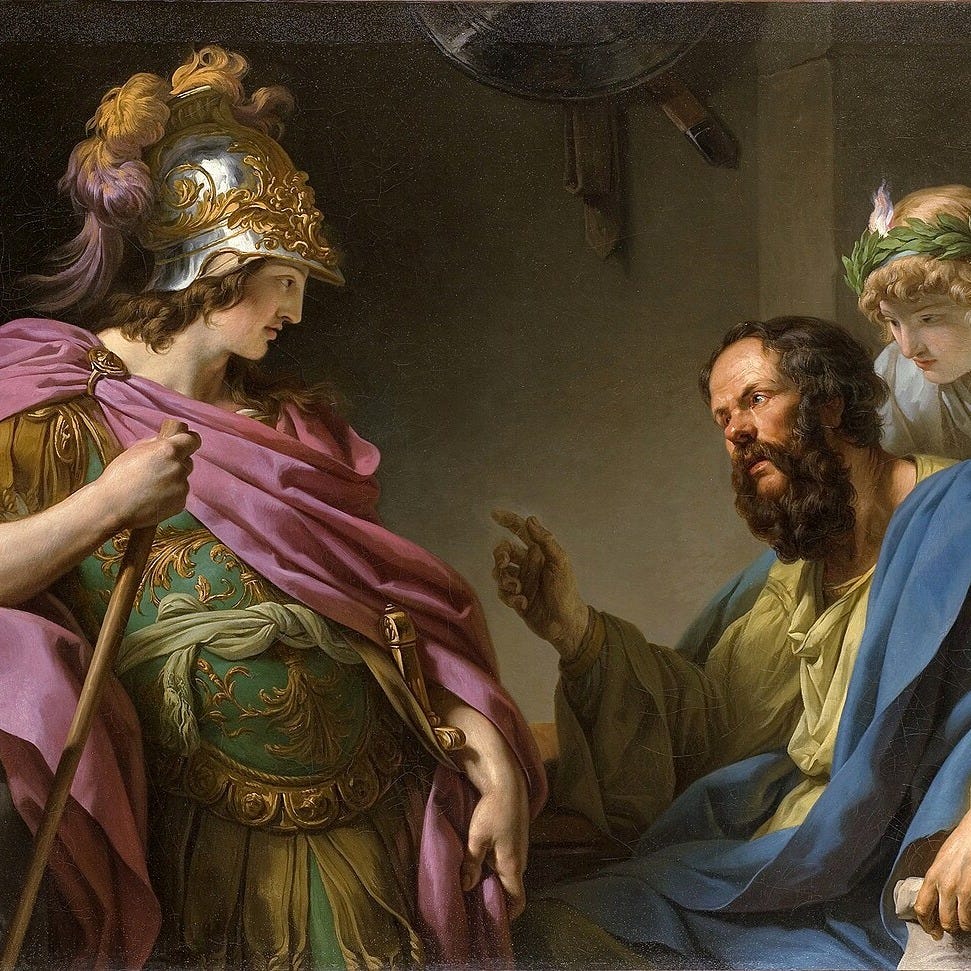
Let us briefly state the role of the teacher in a true education of erotics. In short, Plato teaches in First Alcibiades that the soul needs a mirror as the body needs a mirror.
Yet, what can serve as a mirror for the soul?
Socrates tells us that the mirror of the soul is the eyes of the one who loves you—not a love of the body but a love of the soul. The one who wants your soul to flourish, to love what is beautiful and ascend.
You should see that the pursuit of wisdom, which is often atomized in modern speak, is in Plato a relational, communal act. You need others in your life, others who love you, who can help you see yourself as you are and lead you to who you need to be.
Yet, a good teacher cannot lead the soul to its proper beauties if the teacher is ignorant of erotics.
Much could be said here of how Christ taught and the model of Christian discipleship.
The Role of God in the Erotic
Let us briefly sketch the role of God in the understanding of education as a formation of the erotic appetites of the soul.
First, the love of eros is a love of ascent. The primal desire of mankind is a desire to move from lesser beauties to greater beauties until the soul comes to the “divine beauty-itself,” as Socrates states. Christians see Plato’s observation of nature as something perfected by grace—thus, it is God, Beauty-itself, that stands atop this ladder of love. In short, your infinite erotic appetite finds Infinite Beauty. You should take seriously that your erotic desire was enkindled in you by God to lead you back to Him—the great circle of love.
Second, notice that the eyes of the one who loves you serve as a mirror to the soul. Even in Plato’s First Alcibiades, there exists a neoplatonic gloss that states that the greatest mirror to the soul is God. For who else knows you as you are and as you should be but God? It is coming to love God that we can see our own soul and its loves better—for we need to take seriously the Christian claim that we are made in the image of God, the Imago Dei, and that this invisible image of God is made visible in Jesus Christ.
As such, when you look to Jesus Christ, as Christians teach, you see yourself as you are and as you should be—He is the great mirror of the soul that invites you to become more beautiful as He is beautiful.
Thus true education starts with a serious consideration of who man is and ends with leading mankind to God.
And it is all saturated in love.
Dcn. Harrison Garlick is a deacon, husband, father, Chancellor, and attorney. He lives in rural Oklahoma with his wife and five children. He is also the host of Ascend: The Great Books Podcast. Follow him on X at Dcn. Garlick or Ascend.
It should be made clear that this principle, drawn from First Alcibiades, still uses the term eros to describe the relation between teacher and student, and this is easily conflated with the common pederastic practices of the time; however, in First Alcibiades, Socrates clearly states that his eros for Alcibiades is not for his body but for his soul. Moreover, in the Symposium, an older Alcibiades famously chastises Socrates for not engaging in pederastic practices when he was Alcibiades’ mentor. Socrates is best seen as attempting to recover a true, beautiful understanding of the erotic from a disordered Athenian culture—very similar to today.
It is more clear in the erotics of the Old Testament, as seen in the narrative of Adam and Eve, that eros, especially of the appetitive, finds its final end in marriage—the “lost wholeness” of man finds its remedy in becoming one flesh with the other; however, even Diotima in Plato’s Symposium, acknowledges that the fecundity of the appetitive finds its sense of immortality in having children.
The point about data transfer making teachers replaceable by AI hit close. I’ve been running that experiment from the other side — using AI as a mirror for self-knowledge, and I wrote an essay about it.
It works, up to a point. It reflects accurately. But it doesn’t want anything for me.
My essay ended by admitting the real mirror is the people around you. Turns out Plato said it first, in First Alcibiades, and I just took the long way around.