


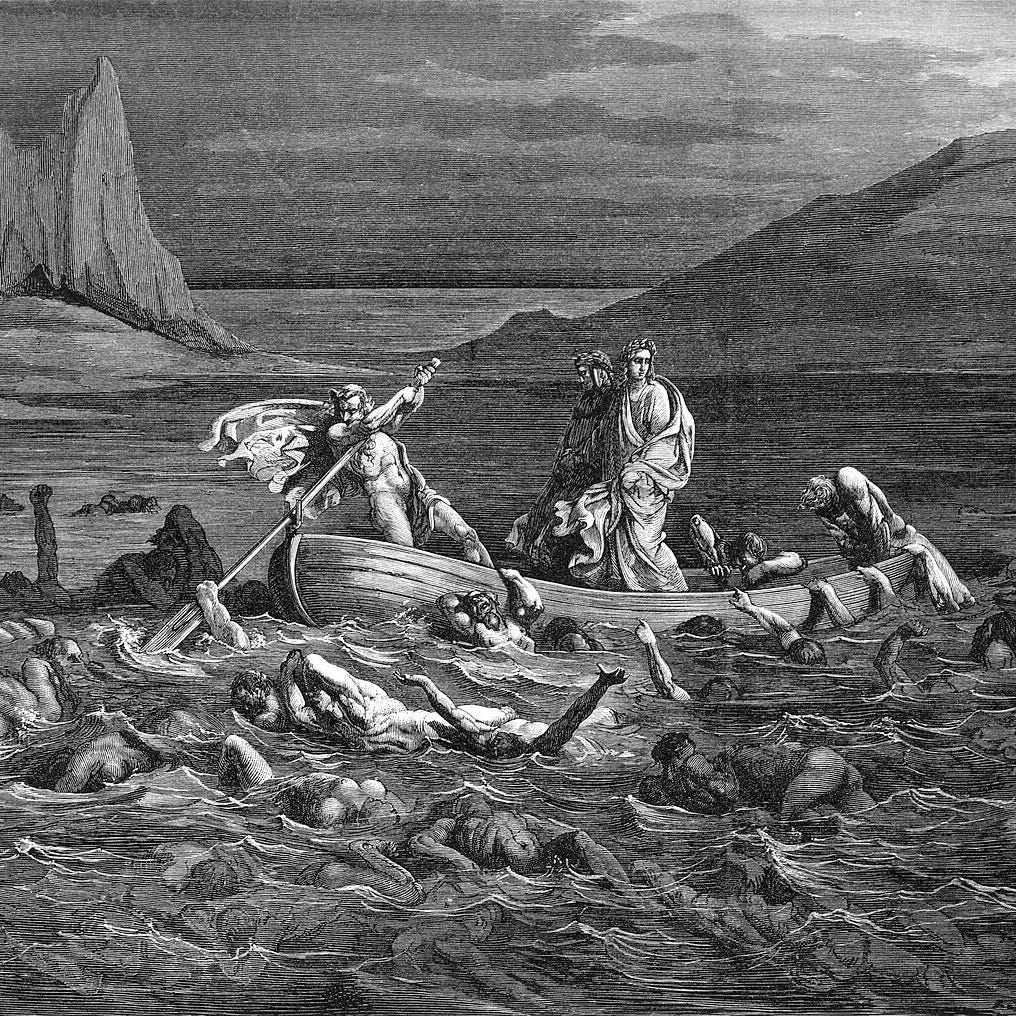
Anger is not a sin.
In fact, not becoming angry when you should be is sinful.
In his Inferno, where Dante the Poet places wrath within hell challenges our modern sensibilities, especially those that lead us to be lukewarm and timid.
Christ became angry—but He did not sin.
Dante gives you a poetic image of Christ’s teachings—an invitation to see anger as a good that must be bridled.
Dante is a master of the soul and, as always, there are a few surprises.
This is a teaser of our members-only deep dives.
We are a 100% reader-supported publication. To support our mission and get our premium content every single week, please consider subscribing for a few dollars per month.
New, full-length articles every Tuesday and Friday
The entire archive of members-only articles and essays
Access to our paid subscriber chat room and community
Check out The Spiritual Harm of Lying
Check out The Spiritual Harm of Gluttony
Check out The Spiritual Harm of Heresy
The Fourth Circle of Hell
Dante’s Divine Comedy tells the story of Dante the Pilgrim’s penitential journey through hell, purgatory, and heaven. It is a masterwork of Christian theology. It is not a literal tale, like a prophetic vision of the actual structure of hell, but rather a moral tale—a lesson on the soul, virtue, and vice.
Dante writes to teach you how to be Christ-like.
In the Inferno, Dante the Pilgrim and Virgil leave the miserly and prodigal souls of the fourth circle and come upon “a swamp that has the name of Styx.” The river Styx, the sordid marsh-like second river of hell, serves as the fifth circle. Here, the Pilgrim sees “muddy people moving in that marsh, all naked, with their faces scarred by rage,” who “fought each other, not with hands alone, but struck with head and chest and feet as well, with teeth they tore each other limb from limb.” These are the wrathful souls, “the souls of those that anger overcame.”
Here is what is fascinating.
Dante the Poet places the wrathful in upper hell, which is characterized by sins of incontinence. In other words, it means that these souls failed to bridle their desires for some good, i.e., lust for the body, gluttony for food, and miserliness or prodigality toward money or earthly treasures. These are not sins of malice but of an inability to control desire. You may say these are either excess or deficient loves for something that is good.
So, how is wrath a sin of incontinence?
First, Dante the Poet treats anger as a good. Anger is not a sin. In fact, in certain circumstances, it would be a sin not to become angry—like when faced with the suffering of the innocence or other forms of injustice (see You Should Be Angry). In sum, wrath is an excess of a good, like gluttony is to food or lust is to the body. But like food or sex, anger is a good.
Remember that Jesus became angry. He cleaned out the temple with a whip, and He became “indignant” at his disciples. He also spoke of things that he “hated.”
Anger is a good. Wrath is an excess.
Second, it should be noted that the sins increase in severity the further Dante the Pilgrim travels down into hell. Moreover, while upper hell is characterized by incontinence, lower hell is characterized by malice—first by violence and then by fraud. So, it is not surprise that Dante the Poet places wrath at the bottom of upper hell, as the sin is both more severe than the other sins of incontinence and more like the sins of malice.
An important distinction that Dante the Poet makes is between wrath and violence. Though wrath can lead to violence, Dante the Poet separates them with the violent being punished in the seventh circle of hell, part of the sins of malice in lower hell.
What is important here is that the wrathful in the fifth circle are those who were wrathful in their hearts—those who may have never acted upon their wrath but allowed it to fester in their hearts, being always short, agitated, and unpleasant with others.
It is easy to say that you have not acted violently toward others.
But it is not easy to say you have bridled wrath in your heart.
As Jesus Christ said (Matt 5:21-22):
“You have heard that it was said to the men of old, ‘You shall not kill; and whoever kills shall be liable to judgment.’ But I say to you that every one who is angry with his brother shall be liable to judgment; whoever insults his brother shall be liable to the council, and whoever says, ‘You fool!’ shall be liable to the hell of fire.”
Dante the Poet gives you the teachings of Jesus Christ in a poetic image—and they are a challenging moral standard. Aligning your interior life with your exterior actions is an impressive feat of self-mastery—one that Christians state can only be done with the help of God’s grace.
In other words, God sets high moral standards but does not abandon you to them—He is there to help you meet them, to be Christ-like.
Like the raging souls in the river, wrath will blind you. It will cloud your intellect and make you act like an irrational beast. And though you may not act on that wrath, your soul will be like those in the river Styx—clawing, gnashing, thrashing in rage.
Yet, an attentive read will show that the river Styx has another type of soul within it.
One not raging… but who reveal another aspect of wrath.
And the identity of these souls is a bit of a mystery.