


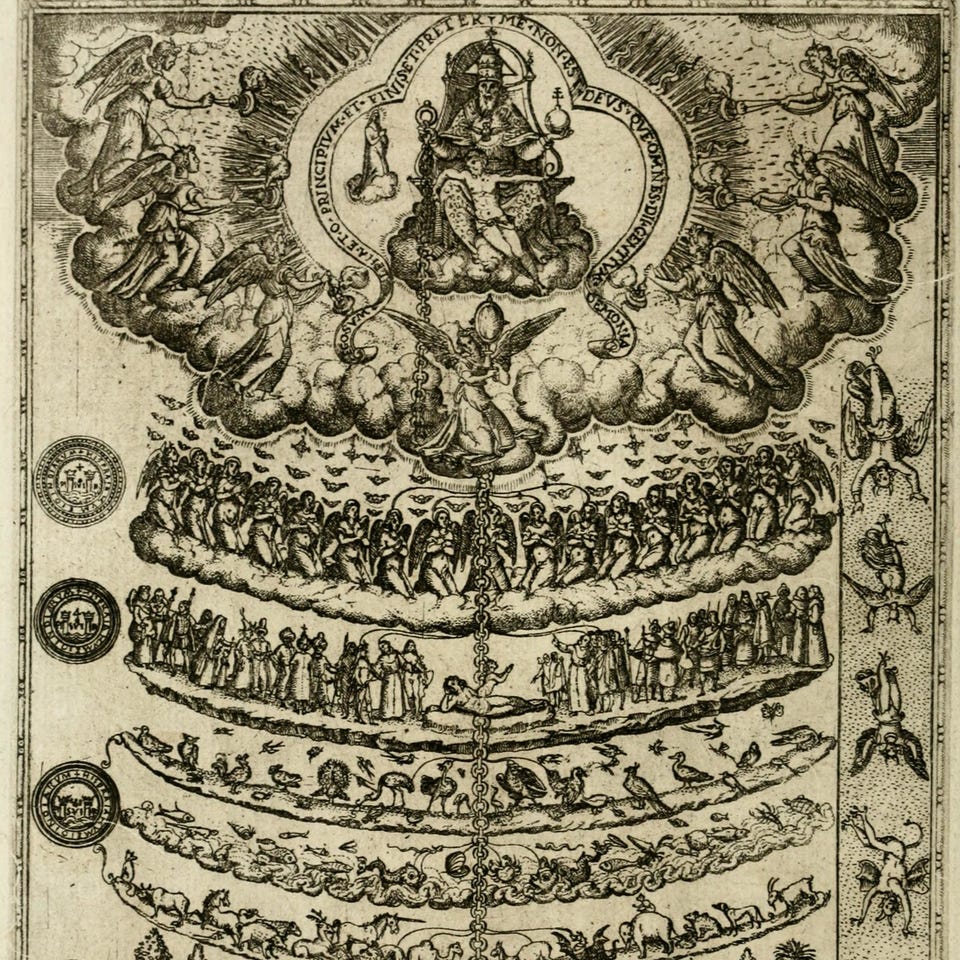
Hierarchy is not a bad word.
Many people equate hierarchy with tyranny—something to be overthrown in the name of autonomy and self-creation.
But for Christians and classical pagans, hierarchy is good and beautiful.
Hierarchy provides the structure by which the soul can flourish in the family, the polis, and the cosmos. Far from being an impediment to freedom, hierarchy sets your soul free.
You were made for hierarchy.
Recovering it is the first step toward a free and beautiful life.
Join our slow read-along of Plato’s Republic!
We begin reading this life-changing book on October 6. Check out the full reading schedule here.
To support our mission and get all our resources, become a paid book club member. In addition to the weekly podcast, you’ll get:
Live book club discussions with Dcn. Garlick & guest scholars (monthly)
In-depth reading guides and essays to lead you through the great books
Access to our incredible community of readers
The full archive of members-only content (guides, essays, and podcasts)

You Need Hierarchy in Your Life
Hierarchy is not a bad word. In fact, hierarchy is a distinctly Christian word that was invented by the great theologian and mystic, Pseudo-Dionysius the Areopagite.1 But too many modern ideologies treat hierarchy as an evil, an artificial imposition of power that must be overthrown. Hierarchy is seen as something tyrannical, something from which modern man must be liberated from in the name of freedom, egalitarianism, and self-creation—but this is a modern fiction.
In truth, hierarchy is good and beautiful.
The classical pagans (e.g., Plato, Aristotle, Cicero), the ancient Hebrews, and the early Christians all saw hierarchy as an authentic expression of reality. Hierarchy is about harmony, proportion, and perfection. It is an expression of justice where each part fulfills its purpose (telos) as part of a greater whole. The higher perfects the lower, and the lower contributes to the perfection of the higher. It gives meaning and structure to words like freedom, authority, and peace.2
Without hierarchy, disorder enters. The whole falls into chaos. Many times hierarchy is torn down in the name of freedom (a Luciferian freedom), only to then leave people enslaved to their own bestial desires (remember, the greatest threat to your freedom is you).
You need hierarchy. Every part of your life was designed for hierarchy.
Let’s take a quick glance at hierarchy in the soul, in the family, in the polis, and in the cosmos.

What Is Authority?
But first, what exactly is hierarchy? To modern ears, it normally reeks of domination and force—but this comes from a misunderstanding of the concept of authority. Moderns, especially after Thomas Hobbes, tend to see any type of authority of one person over another as a form of dominance. It is the subordination, often violent, of one will over the other. In other words, the modern myth is that man is completely equal in all ways, a perfect egalitarianism; thus, introducing hierarchy into that radical equality is always a curbing of someone’s self-creation. Authority is at best a necessary evil, but it remains something that always grates against the autonomy and individualism of modern man.
But this view is not the view of the Bible or the classical pagans.
Authority is not a dominance but an act of care and perfection. One who has authority over the other is charged with their good and cultivating in them that which is excellent. If someone has authority over the other it is the responsibility of the one in authority to help those under his or her care to fulfill their purpose.
Think of a garden and a gardener. The gardener is charged with the good of the garden, but this is not done by force or dominance. If so, the garden will wilt and die; rather, the gardener must know what makes each plant grow and provide that which is good for the plant to flourish.
It is this ancient concept of authority that informs the hierarchy of the soul, the family, the polis, and the cosmos. Again, one of the significant dangers of the modern era is that it uses the grammar of classic pagans and of Christianity and guts it of its original meaning—filling it back in when a definition saturated in modern ideologies that, after awhile, simply become normative.3
You must reclaim your grammar to reclaim your intellect.
What is new on the Ascend Book Club?
Here are a few resources we’ve posted recently on our Book Club:
Hierarchy in the Soul
Soulcraft comes first. You must have a beautiful soul, and the beauty of the soul is accomplished by establishing and maintaining a proper hierarchy within it. Plato, through his characters, will speak of this mainly in the grammar of justice—for it is the virtue of justice that harmonizes the parts of a whole and has them fulfill their purpose (telos).
In sum, the soul has three parts that exist in hierarchy: the intellect that loves truth, the spirited part that loves nobility, and the appetitive that loves pleasure. These loves must remain ordered. The intellect governs with the assistance of the spirited, keeping the appetitive in check. When the appetitive seizes control, the soul is inverted—desire for truth is shoved to the bottom and the desire for pleasure climbs to the top. As Socrates tells us, this is the life of a cow—a life with your head down, never looking at the stars, but focused on food and sex.
The hierarchy of the soul is maintained by virtue: prudence perfects the intellect, courage the spirited, temperance the appetitive, and justice binds them into a beautiful harmony. Virtue is a sign of health, order, and beauty in the soul.
Notice that the well-ordered soul, the soul in hierarchical order, is one that flourishing.
Would the soul be better if it was egalitarian? Would it better if it allowed the intellect and the appetitive to share leadership of the soul equally? Or maybe the intellect and the appetitive should share “power” by rotating who governs. Maybe the parts of the soul should vote to see who should lead? No, this all seems comical and a clear invitation to disorder and vice—but it is exactly what we do to the hierarchies of the family, the polis, and even religion.
Your life will flourish in obedience to hierarchy.
But first, you have to be able to wipe away the modern unrealities and recover the hidden hierarchies of everyday life.
In this, you can flourish and ascend.
