


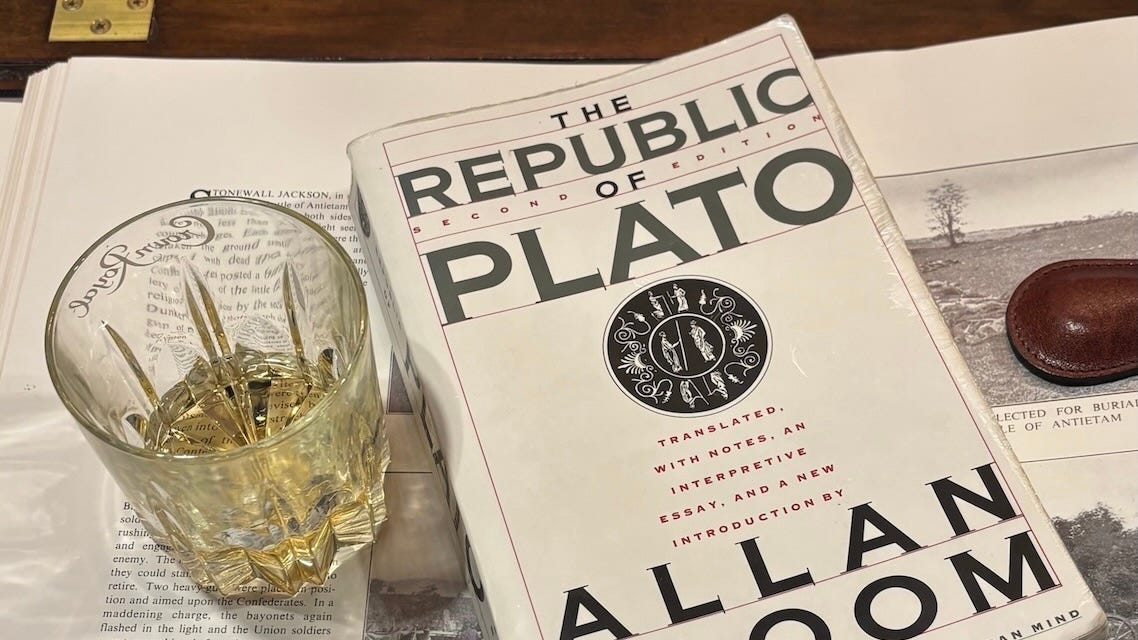
Today on Ascend: The Great Books Podcast, we start our slow, beautiful pilgrimage through arguably the most important book in Western philosophy: Plato’s Republic. It is about justice and whether justice is more profitable to the soul than injustice—but along the way it provides rich conversations on the soul, virtue, education, metaphysics, and the afterlife. If you read this book and read it well, it will change your life.
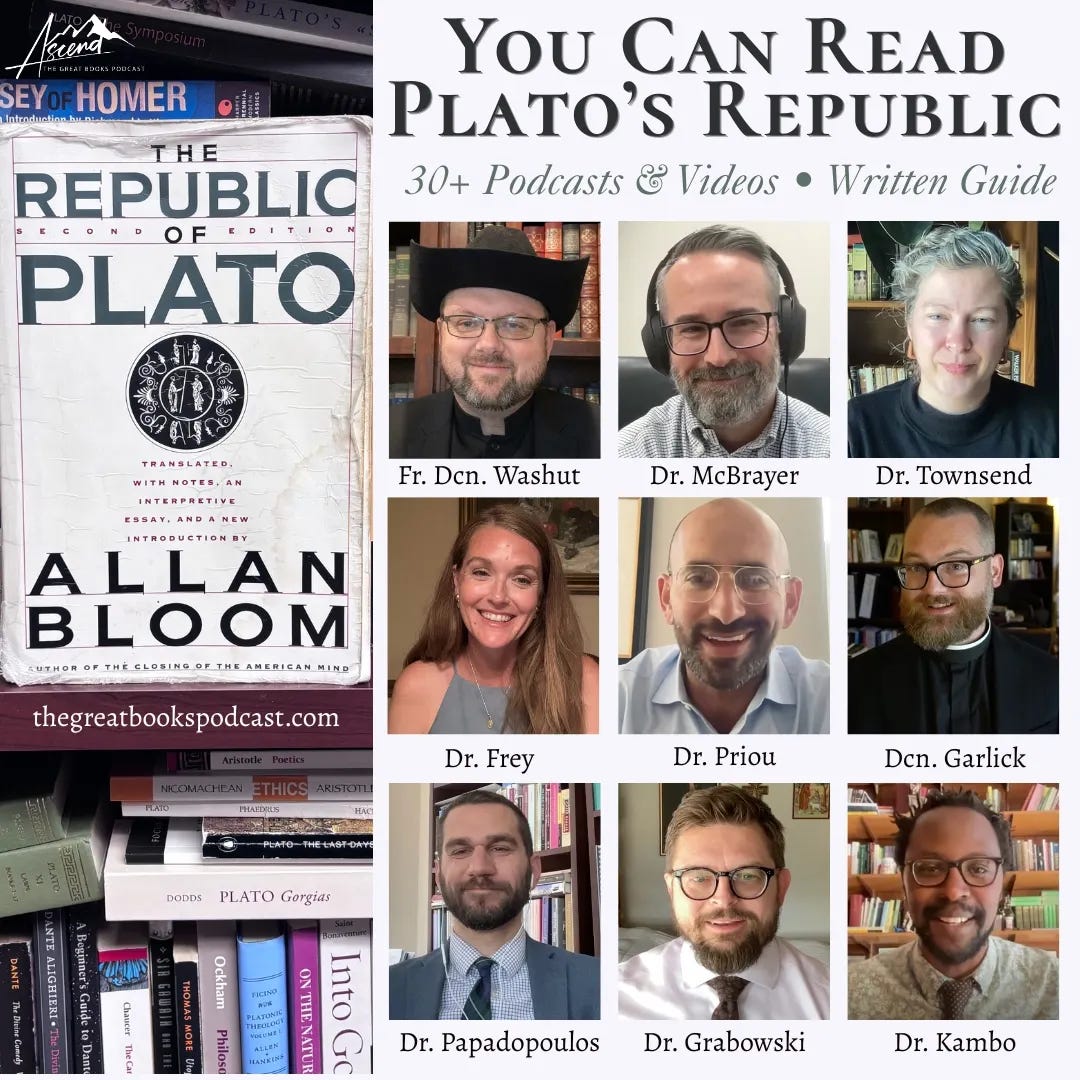
And we have an excellent guide and mentor to walk us through the opening of Plato’s Republic and the dialogue with Cephalus in Book One (327a-331d), Dr. Alex Priou who currently serves as a professor of political philosophy at the University of Austin.
Today we start something life-changing.
Join our slow read-along of Plato’s Republic!
We begin reading this life-changing book on October 6. Check out the full reading schedule here.
To support our mission and get all our resources, become a paid book club member. In addition to the weekly podcast, you’ll get:
Live book club discussions with Dcn. Garlick & guest scholars (monthly)
In-depth reading guides and essays to lead you through the great books
Access to our incredible community of readers
The full archive of members-only content (guides, essays, and podcasts)

Plato is philosophy. To summarize a famous line, all of Western philosophy is a series of footnotes to Plato, and Plato’s Republic is his masterwork. He does not offer you a sterile, intellectual idea that is neat to contemplate—he makes claims on your soul. For Plato, philosophy is transformative. The goal of the pursuit of wisdom is to have a good soul, a beautiful soul.
Further Resources to Help You Read the Republic:
“I went down to the Piraeus.” The famous opening line gives you much to contemplate, and Dr. Alex Priou is a wonderful guide. We have the verb of descent, which will be important to the entire text, and we have the Piraeus, the port of Athens, which is hosting a new festival to a new goddess. Moreover, Socrates narrates the entire Republic to an unnamed listener who never interrupts… but this allows Socrates to give commentary on the argument he otherwise could not. Dr. Priou shows us how the prologue to the Republic is simple but rich with meaning—a great introduction to how Plato teaches.
In the house of Cephalus, age, wealth, and the old myths give the first account of justice. Asked the greatest good of his money, the old metic does not speak of friends or food. He speaks of the myths he laughed at when he was young, and of the peace of facing them without unpaid debts. Justice, for him, is telling the truth and giving what one owes. Socrates asks whether you return a borrowed weapon to a man who has gone mad. Cephalus cannot defend the rule he has lived by. He laughs, leaves the argument to his son, and goes back to the sacrifices. Cephalus leaves, but his conversation will haunt the entire Republic—as the text begins with a descent and religious myth and will end with an ascent and a religious myth.
Be sure to check out our entire reading schedule, so you can be sure to read alongside us.
Also, thank you to the CLASSIC LEARNING TEST for sponsoring our first month of Plato’s Republic. They are a really excellent group of people trying to change the landscape of education in America. Go check them out.
A good path is before us.
Let’s take it and ascend.
Dcn. Harrison Garlick lives in rural Oklahoma with his wife and five children. He serves as a deacon at Holy Family Cathedral and as Chancellor & General Counsel for the Roman Catholic Diocese of Tulsa. Follow him on X at Dcn. Garlick or Ascend.


