


Today on Ascend: The Great Books Podcast, Deacon Harrison Garlick and Mr. Thomas Lackey sit down with Dr. Louis Markos—author of From Plato to Christ—for a lively, wide-ranging conversation on how Platonic thought prepared the world for the Gospel.
From the fullness of time and the meeting of Athens and Jerusalem to C.S. Lewis, classical education, the myths of the Republic, and why even modern Christians still need Plato, this is a rich exploration of the intellectual roots of the faith and the enduring power of the Great Books.
Dr. Markos is a whirlwind on a mission.
Join us.
And THANK YOU again to the Classic Learning Test for sponsoring this episode.
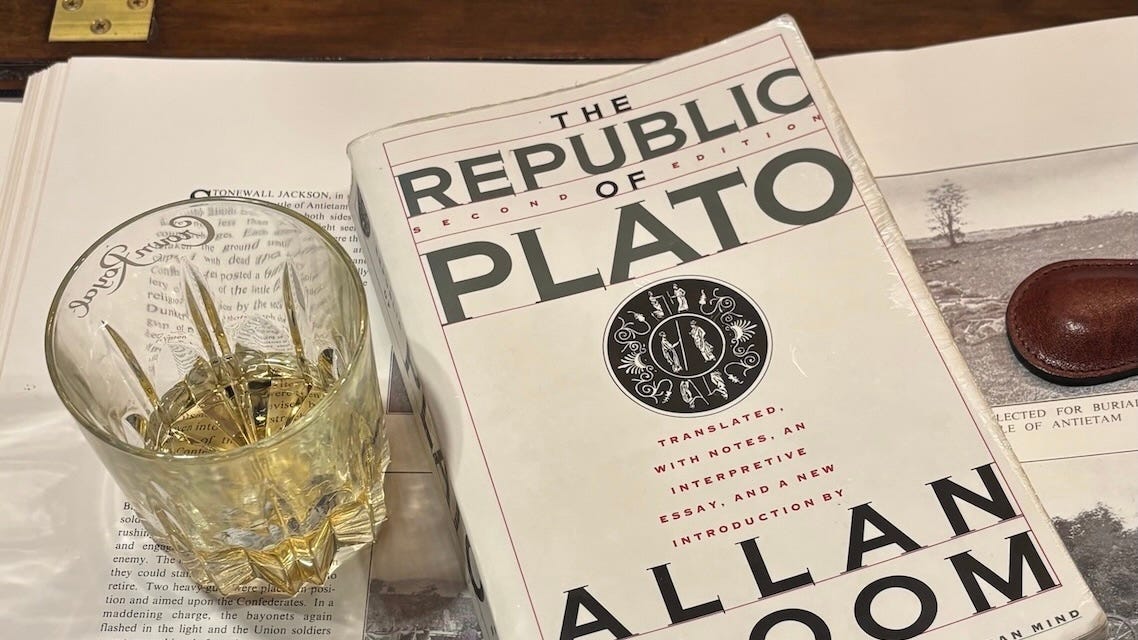
Join our slow read-along of Plato’s Republic!
We begin reading this life-changing book on October 6. Check out the full reading schedule here.
To support our mission and get all our resources, become a paid book club member. In addition to the weekly podcast, you’ll get:
Live book club discussions with Dcn. Garlick & guest scholars (monthly)
In-depth reading guides and essays to lead you through the great books
Access to our incredible community of readers
The full archive of members-only content (guides, essays, and podcasts)

Dr. Markos opened by framing his lifelong project of uniting Athens and Jerusalem—the Greco-Roman and Judeo-Christian inheritances that together shaped the West. He argued that the “fullness of time” was not only political and linguistic but intellectual: Greek philosophy, especially Plato, prepared the human heart for the Gospel through general revelation. God did not ignore the nations; He used reason, conscience, and imagination to plant redemptive analogies that pointed toward Christ.
Dr. Markos noted that this recovery is now happening among evangelicals, who are reclaiming the classical tradition just as many secular universities abandon it, and that classical Christian education is quietly reintroducing Plato, the Church Fathers, and a hierarchical view of reality to a generation once wary of anything outside the Bible alone.
Resources on Plato’s Republic:
The conversation then turned to Plato’s specific role as a kind of pre-evangelism. Dr. Markos distinguished Socrates’ negative work of clearing false definitions from Plato’s positive construction of the Good, the True, and the Beautiful. He highlighted how the Republic uses the just and unjust man, the city-soul analogy, and the Myth of Er to show that injustice disorders the soul itself—an insight modern students often encounter first in Plato rather than in Scripture. Myths, he explained, are not mere stories for those who cannot grasp philosophy; they incarnate truths that pure dialectic cannot fully express, especially the reality of final judgment and the damage sin does to the soul.
Deacon Garlick and Thomas Lackey pressed further on St. Augustine’s decisive Christianization of the Forms: relocating them in the divine Logos and affirming that God knows both universals and particulars, so that Platonic metaphysics is not an alien overlay but something already latent in the New Testament’s language of participation, shadows, and heavenly patterns.
The episode closed with C.S. Lewis as the modern bridge who makes Plato accessible to Protestants. Dr. Markos pointed to the heavenly Narnia that is “more real” than the earthly one, the Silver Chair’s psychological undoing of the children’s knowledge of Aslan and the sun, and Lewis’s consistent realism against nominalism.
Throughout, the guests returned to the practical stakes of the Republic for first-time readers: follow the through-line that justice is better than injustice even when it costs everything, let the allegory of the cave reorient what counts as real, and treat Plato not as an opponent to be purged but as a candle whose light is completed, not extinguished, by the greater light of Christ.
If you’re interested in reading more on how Plato and the broader Hellenized culture impact the Gospel, check out “Do Christians Owe a Debt to Homer” and “How Plato Helped St. Augustine Convert to Christianity.”
Good work!
Next week we start Book Two of the Republic. Check out our reading schedule for more information.
Dcn. Harrison Garlick lives in rural Oklahoma with his wife and five children. He serves as a deacon at Holy Family Cathedral and as Chancellor & General Counsel for the Roman Catholic Diocese of Tulsa. Follow him on X at Dcn. Garlick or Ascend.


