


Plato does not lecture you.
Most people want a lecture, because it is easier. But Plato makes you work for the truth. He hides it in drama, irony, bewilderment, and love. The story is part of the teaching. The setting, the speakers, and even your own confusion are a philosophic lesson.
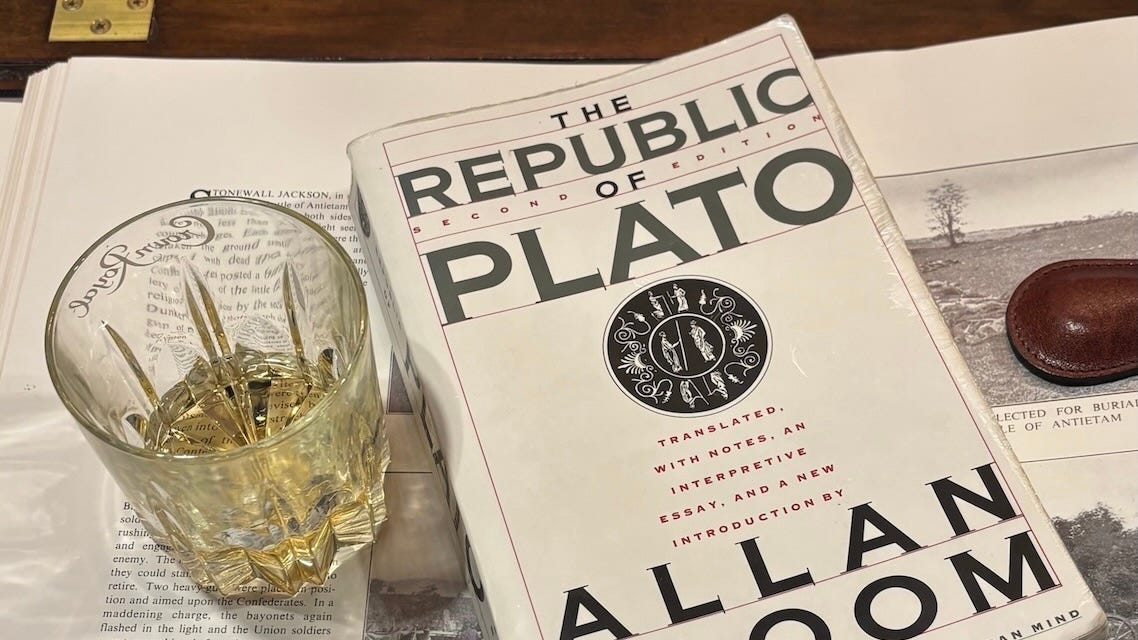
Next week we begin Plato’s masterpiece, the Republic. Plato is philosophy. Read this book well, and you have a guidepost for the entire Western tradition. The Republic is worth the work. It will change your life.
So let’s learn to read Plato well.
Join our slow read-along of Plato’s Republic!
We begin reading this life-changing book on October 6. Check out the full reading schedule here.
To support our mission and get all our resources, become a paid book club member. In addition to the weekly podcast, you’ll get:
Live book club discussions with Dcn. Garlick & guest scholars (monthly)
In-depth reading guides and essays to lead you through the great books
Access to our incredible community of readers
The full archive of members-only content (guides, essays, and podcasts)

Questions to Read Plato Well
Today on Ascend: The Great Books Podcast, we are preparing to read Plato’s Republic (we start next week!). Before turning to that long and demanding text, we ask a simple question: how do you read Plato well?
Plato does not write treatises or lectures. He writes dialogues, and the setting, the characters, the irony, and even the moments of confusion (aporia!) are part of the teaching. The podcast takes up the questions that help a first-time reader get started on the right foot. Overall, however, we do not read Plato to “be smart” or brag we’ve read Plato. We read Plato to have a beautiful soul. We take him seriously as a teacher who can help us pursue the true, good, and beautiful.
Here is a list of the major questions that are discussed on the podcast today:
Why read Plato?
Why is the drama important?
Are the dialogues historical transcripts?
What is the Socratic method?
What is Socratic irony?
What is the art of dialectic?
What is aporia?
What is eros?
What is pleonexia?
What are the parts of the soul?
Again, we read Plato to better understand the good life and to have a good, healthy soul.
A Few More Resources
Be sure to check out the MASTER CALENDAR for our reading schedule for Plato’s Republic. Also, if you’re interested in a deeper dive into eros, see "Rediscovering Holy Eros” (one of the most popular articles on Ascend). Moreover, you can read more about pleonexia and its dangers at “The Greatest Threat to Your Freedom is You.” Last week, to prep for the Republic, we published “How to Read Plato’s Republic like C.S. Lewis.” Finally, regarding Socratic irony, read “How a Man Pretending to be Drunk Helps You Read Plato.”
Next week we start Plato’s Republic!
Dcn. Harrison Garlick lives in rural Oklahoma with his wife and five children. He serves as a deacon at Holy Family Cathedral and as Chancellor & General Counsel for the Roman Catholic Diocese of Tulsa. Follow him on X at Dcn. Garlick or Ascend.


