


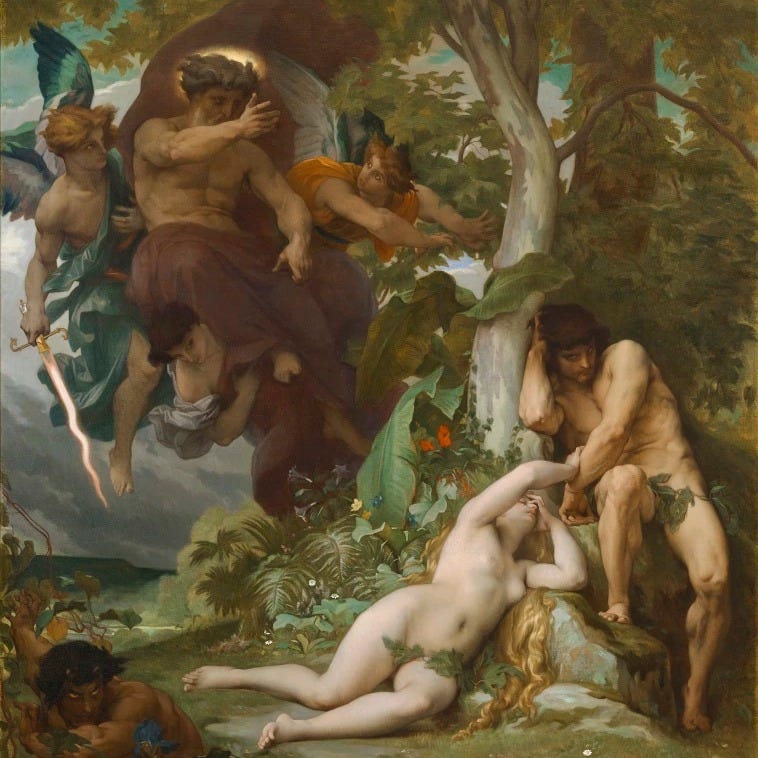
The story of Adam and Eve is a primordial map of the human condition.
Yet many are not willing to follow it.
The story of the punishment of our first parents holds many subtle, quiet lessons—like the first Messianic promise or why God commits the first act of violence.
You need to read the map carefully.
Let’s look at six observations that reveal something about Adam and Eve—and us.
Reminder: this is a teaser of our members-only deep dives.
To support our mission and get our premium content every week, upgrade for a few dollars per month. You’ll get:
New, full-length articles every Tuesday and Friday (or Saturday!)
The entire archive of members-only essays
Access to our paid subscriber chat room
Exploring the Sacred Tale of Genesis
The primordial narrative of Adam and Eve should be taken seriously. Christians see in this text the primal mapping of mankind—who he is, his relationship to God, and how the relationship suffers. We have seen how “the woman,” is the pinnacle of creation and how her genesis provides a template for the union of the sexes. We have taken up similar studies of femininity in our Christian neoplatonic exploration of women as icons of God’s beauty and in our study of Penelope, the wife of Odysseus, as an image of fidelity and immortal glory.
Yet, from this high praise we plummet into the story of the fall of mankind, and we looked at why “the woman” chose Satan over her husband as the interpreter of God’s will (and the problem of Adam as a weak husband, lawgiver, and protector).
Now, let us finish the story and look at how Adam and Eve were punished and how this simple story sets up the history of mankind.
Six Observations on the Punishment of Mankind
Let us look at six notable observations about the story of God punishing Adam and Eve (Gen 3:8-24).
1. Does God have a body?
First, Adam and Eve hear the sound of God walking in the Garden (v. 8). How should you handle the fact that this seems to limit God to a body? Well, you could simply claim it is an anthropological metaphor, like when Scripture speaks of God’s heart, His eyes, or His hands. You could also claim that God is actually walking bodily in the Garden of Eden, or at least what appears to be bodily, by arguing “God” here is a pre-incarnate Christ.1
Lastly, without being contradictory to the infallibility of the Scriptures, you could acknowledge that in the Old Testament, God is revealing more and more about Himself. Abraham is told of the covenant with God’s chosen people. Moses is told the name of God and how He wants to be worshiped. Solomon is able to build the Temple. Isaiah has a better understanding of the Messiah. This is called the Divine Pedagogy or how God reveals Himself to mankind over time. In the Old Testament, they are coming to know more and more about God, while in the New Testament everything is revealed in Jesus Christ—as such, Christians are not awaiting any new revelation (only a continuous contemplation of the Truth of Jesus).
Thus, there may be a legitimate question here at the beginning of the Bible about how God presents Himself and what exactly are His divine attributes—as mankind will have to learn more about Him over time. Notice that God also seems to have to come down to understand what is happening at the Tower of Babel (Gen 11). Lastly, a significant lesson for the Israelites during their exile was that their God was not simply the God of Israel but the God of everything—and that their nation suffering bondage did not equate to their God being defeated by another nation’s god.
2. Does God not know all things?
In the next verse, God walks in the Garden of Eden and asks where Adam and Eve are. A flat read here would call into question God’s knowledge and whether He is truly omniscient (all-knowing). While one could make an argument of Divine Pedagogy and that here, at the beginning of the Bible, man is not sure about the full nature of God’s knowledge, it seems more likely that the asking of “where are you” is a rhetorical device inviting Adam and Eve to step forward and confess their wrongdoing (v. 9). Parents should be familiar with this indirect rhetoric to invite your children to confess.
Yet, Genesis narrative holds quieter, deeper questions.
Is the serpent simply an animal—or something more? What does Genesis say? What is the true meaning of the enmity God places between the woman and the snake? And why does the first act of violence in Scripture come from the hand of God Himself?
Genesis is not a children’s story.
It is the primordial map of the human condition.
The question is whether modern man is willing to follow it.
